Science
Academic Research Foundations
Peptaris builds on a body of academic research from our scientific founders and their collaborators at the University of Pennsylvania and other institutions. The work spans AI-guided peptide discovery, generative molecular design, experimental optimization, and computational approaches to understanding biological activity and molecular properties.
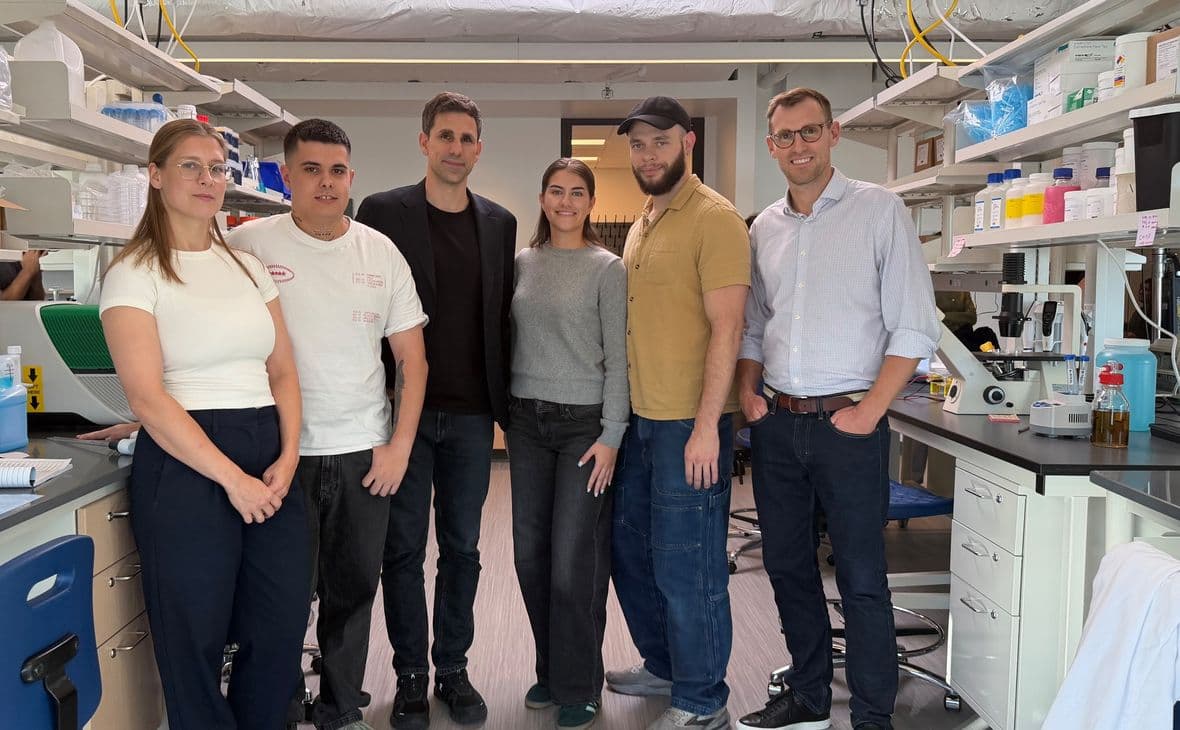
Research topics
- Machine learning for biomaterials design
- Molecular de-extinction
- Peptide antibiotic optimization
- Key-cutting machine approach
- Peptide structural plasticity
- Multi-task Bayesian optimization
- Azapeptide GLP-1 analogue
- Knowledge priors from literature
- Self-driving datasets
- AI-programmable therapeutics
Publications
Selected Work
Broader Perspectives on AI-Guided Molecular Design
Machine learning for biomaterials design (opens in a new tab)
Nature Reviews Bioengineering / 2026 / Xia et al.
A review of computational approaches to design and optimization across biomaterial classes, spanning surrogate modeling, generative design and active learning.
AI-Guided Peptide Discovery and Design
Deep-learning-enabled antibiotic discovery through molecular de-extinction (opens in a new tab)
Nature Biomedical Engineering / 2024 / Wan et al.
Academic research using computational methods to identify antimicrobial peptide candidates from extinct organisms, with experimental follow-up.
Nature Machine Intelligence / 2026 / Torres et al.
Research on generative optimization of peptide antibiotics, including synthesis and experimental characterization of candidates.
Tailored structured peptide design with a key-cutting machine approach (opens in a new tab)
Nature Machine Intelligence / 2025 / Leyva et al.
Research relevant to the computational design of peptides and exploration of molecular design space.
Predictive Modeling and Molecular Optimization
Peptide structural plasticity is predictable from sequence and environment (opens in a new tab)
bioRxiv / 2026 / Preprint / Torres et al.
A preprint describing a computational approach to modeling peptide structure in varying chemical contexts.
Scaling multi-task Bayesian optimization with large language models (opens in a new tab)
ICLR / 2026 / Zeng et al.
Conference research on methods for transferring information between optimization tasks.
Academic research / 2025 / Preprint / He et al.
Collaborative academic study of chemical modification and biological evaluation of a peptide therapeutic.
Scientific Data and AI for Therapeutic Design
NeurIPS / 2025 / Jones et al.
Conference research describing structured data resources derived from scientific literature to support modeling and molecular design.
arXiv / 2026 / Preprint / Jones et al.
Preprint investigating computational extraction of structured biomedical information from scientific literature.
bioRxiv / 2026 / Preprint / Munsamy et al.
Collaborative preprint exploring foundation models and therapeutic molecular design.
Partnerships